


The Lithium Bubble
Updated: Jul 22
Given that green renewable energy has been more popular over the past ten years, particularly in the case of electronic vehicles, do we truly understand what keeps these vehicles operating? The answer is lithium. Do you recall the Australian lithium industry's boom and bust cycle? As most people are aware, Australia is the country with the greatest mineral exports worldwide, accounting for about half of the world's lithium energy supply exports. Furthermore, Australia has a significant role in the global export of natural resources. As everyone has heard, mining has contributed to the exports meant to strengthen Australia's economy. What happens now that the lithium bubble has burst?
What precisely is lithium, then? Lithium is a type of mineral commodity that is primarily utilised in the electric vehicle (EV) industry. Additionally, lithium is also utilised in aerospace alloys, renewable energy stores, and other key industries, such as the pharmaceutical industry. In accordance with Geoscience Australia, the bulk of Australia's lithium deposits are located in Western Australia (Greenbushes Mine, Pilgangoora Mine, Wodgina, etc.).The two most popular forms of lithium that are being exported to the world are refined lithium chemical, which is thought to be less common because Australia tends to export raw materials rather than refined lithium, and spondumene concentrate (raw lithium ore), which is a rich mineral from the hard rock that maintains the international spotlight (Geoscience Australia, 2018).

According to ABS data, Australia has been the world's leading provider of lithium for a number of years, surpassing South American nations like Argentina and Chile as well as Zimbabwe, and accounting for at least 46% of the world’s lithium supply (Bhutada, 2023). According to the current projection, the price and quantity of lithium exports are expected to rise from 2962 to 3887 Kt, a mere 31.62 percent increase for the current years.

Approximately 90% of the lithium Australia produces is used for global exports, and most of it goes to China (Australian Bureau of Statistics, 2022). From China's perspective, the country imports about half of the world's total lithium and produces about 70% of the goods that require lithium. Globally, we are experiencing high growth of EV demand, which has increased by 41.5 percent since 2024, the rapid expansion of Energy Storage Systems (ESS) systems, and the high import dependency for over 67.1 percent of the world's lithium (Zheng et al., 2025).
But why is Australia well-known for exporting lithium to meet demand worldwide? As is well known, we are in the process of transitioning from using fossil fuels to more environmentally friendly energy sources in order to reduce carbon emissions. Furthermore, according to Australia's geology, hard rock mining for lithium is expanding more quickly than other mining companies that have been in business for a long time and suitable in all aspects of EV projects.
What matters more is that Australia and China are of close trading relationship, particularly in the EV industries, which account for most of Australia's lithium supply (thediplomat.com, n.d.).
Major contributions to the green energy sectors and the transition to renewable energy have come from lithium itself. But do all the benefits come with any trade-offs or hidden costs?
According to the Market Index's historical prices for lithium, if we closely examine the historical 10-year prices, we can see that price volatility tends to be extreme, starting from solid ranges between 7500 and 8000 dollars per ton, experiencing a steady increase until the surge up to roughly 78000 dollars per ton, and lately tending to decrease over time down and bust to the 24000 dollars per ton, and currently experiencing price stabilisations and market correction as a result of the price crash (Trading Economics, 2025).
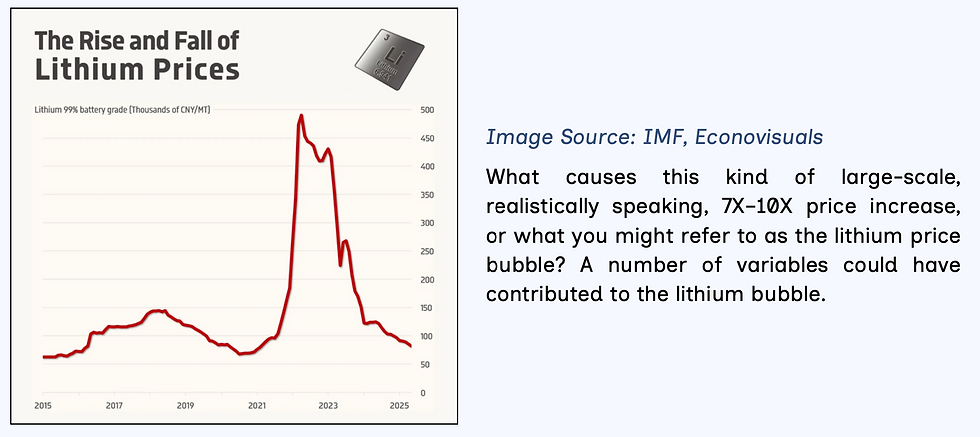
The bubble may be caused by several variables, such as government subsidiary programs (WA) for ongoing mining projects, particularly for large-scale mining corporations like Pilbara Mineral, Talison Lithium, and others, and an optimistic viewpoint from external parties due to the price surge in lithium, which is supported by the majority of external investment groups. The choice to increase the total production of lithium supplies may be influenced by the possibility that certain companies may double down on their new output and other misleading price signals. However, because a large portion of the supply was stockpiled due to extreme optimism, the estimated demand did not increase as quickly as expected. In actuality, though, there is a significant discrepancy in the increasing supply of lithium, which is supported by excessive confidence and low demand from China. This has led to a significant pricing discrepancy (Wang et al., 2023).
You might also question how this relates to Australia's economy, particularly with regard to Western Australia (WA). Reports from mining conglomerates like Pilbara and other businesses and subsidiaries have dropped substantially, particularly when it comes to net revenues during the mini recession cycle. This has a cascading effect on other mining- related businesses. We can observe a small decline in lithium export earnings, employment losses, financing burn over with project cycles, and other issues. Does it actually have an impact on WA's GDP? Not really; lithium mineral accounts for 10–15% of all mineral products, but it still has an impact on a particular area that is highly dependent on a certain mineral. It nevertheless keeps an eye on the previous consequences because Australia's GDP isn't totally dependent on lithium. Overall, the durability and diversity of the Australian economy are demonstrated by the fact that, notwithstanding localised disruptions caused by changes in lithium production and related industries, Western Australia's contribution to the national GDP is largely unaffected.
References
Geoscience Australia (2018). Lithium. [online] Ga.gov.au. https://www.ga.gov.au/scientific-topics/minerals/mineral-resources-and-advice/australian-resource-reviews/lithium.
Australian Bureau of Statistics (2022). Insights into Australian Exports of Lithium | Australian Bureau of Statistics. [online] Australian Bureau of Statistics. https://www.abs.gov.au/articles/insights-australian-exports-lithium.
thediplomat.com. (n.d.). The Mending Australia-China Relationship: Powered by Lithium? https://thediplomat.com/2022/11/the-mending-australia-china-relationship-powered-by-lithium/.
Trading Economics (2025). Lithium. [online] Trading Economics. https://tradingeconomics.com/commodity/lithium.
Bhutada, G. (2023). This chart shows more than 25 years of lithium production by country. [online] World Economic Forum.
Wang, X.-Q., Qin, M., Moldovan, N.-C. and Su, C.-W. (2023). Bubble behaviours in lithium price and the contagion effect: An industry chain perspective. Resources Policy, [online] 83, p.103725. doi:https://doi.org/10.1016/j.resourpol.2023.103725.
Zheng, L., Chen, G., Wen, B. and Bao, W. (2025). Analysis of lithium demand for electric vehicles from supply and demand perspectives under China’s carbon peak and neutrality goals. Waste Management, 202, p.114822. doi:https://doi.org/10.1016/j.wasman.2025.114822.


Comments